
Global Impact: World Sustainability & ESG Summit Amsterdam 2026 Explores Future-Forward Solutions

Get ready for the World Sustainability & ESG Summit Amsterdam 2026! This event is all about figuring out how businesses and the world can do better. We're talking about making things more sustainable and looking at how companies handle environmental, social, and governance issues. It's a big deal for anyone trying to make a positive impact. The summit in Amsterdam will bring together a lot of smart people to share ideas and find new ways to tackle some tough problems we're all facing.
Key Takeaways
- The summit will focus on how companies can improve their sustainability efforts and overall performance.
- Discussions will cover ways to make workplaces more equal and improve people's well-being.
- Expect talks on how to source materials ethically and build better relationships with everyone involved in a business.
- The event will look at new ideas in sustainable finance and how companies are adapting to changing rules.
- Attendees will learn about using AI and data to improve ESG tracking and decision-making.
Pioneering Sustainable Futures at the World Sustainability & ESG Summit Amsterdam 2026

The World Sustainability & ESG Summit Amsterdam 2026 is shaping up to be a major event for anyone serious about the planet and business. It's not just another conference; it's a place where real ideas are discussed and future plans are made. Think of it as a hub for people who want to make a difference, not just talk about it. The goal is to move beyond just talking about sustainability and actually put it into practice, making sure businesses can grow while also being good to the environment and people.
Driving Corporate Sustainability and Performance
This section really gets into how companies can actually do sustainability, not just say they do. It's about making it part of the business itself, so it helps the company perform better, not just tick boxes. We'll look at how integrating environmental, social, and governance (ESG) factors can lead to better financial results and a stronger brand. It’s about finding that sweet spot where doing good and doing well go hand-in-hand.
- Integrating ESG into core business strategy.
- Measuring and reporting on sustainability performance.
- Building a business case for sustainable practices.
Making sustainability a core part of how a company operates means it's not an add-on, but a fundamental part of its identity and operations. This approach helps in attracting investors and customers who care about these issues.
Fostering Equality and Well-being
Beyond just the environment, this part of the summit focuses on the 'S' in ESG – the social side. It’s about making sure everyone is treated fairly and has a good quality of life, both within companies and in the wider community. This includes looking at things like fair wages, good working conditions, and making sure everyone has a chance to succeed. It’s about building a society where people are valued and supported.
- Promoting diversity and inclusion in the workplace.
- Improving employee well-being and mental health support.
- Community engagement and social impact initiatives.
Ethical Sourcing and Stakeholder Engagement
This is where we get down to the nitty-gritty of how products are made and who is involved. It’s about making sure that the materials and services companies use are sourced responsibly, without harming people or the planet. Plus, it’s about talking to everyone who has a stake in the business – employees, customers, suppliers, and the local community – and listening to what they have to say. Open communication is key here. You can find out more about cutting-edge sustainable innovations and connect with leaders in this area.
- Mapping and managing supply chain risks.
- Building transparent and ethical supplier relationships.
- Strategies for effective stakeholder dialogue and feedback.
Navigating the Evolving ESG Landscape
Emerging Trends and Market Evolution in Sustainable Finance
The world of finance is really changing, and it's not just about making money anymore. Investors are looking closer at how companies handle environmental, social, and governance (ESG) issues. This means that how a company treats its workers, its impact on the planet, and how it's run are becoming just as important as its profit margins. We're seeing new financial products pop up, like green bonds and sustainability-linked loans, that specifically support companies doing good. It’s a big shift, and understanding these new trends is key for any business wanting to stay relevant and attract capital.
Here's a quick look at what's happening:
- Growth in ESG Funds: More money is flowing into funds that focus on ESG criteria.
- Regulatory Push: Governments are introducing rules that push companies to be more transparent about their ESG performance.
- Data Demands: Investors want better, more reliable data to make informed decisions.
The financial markets are increasingly rewarding companies that demonstrate strong ESG performance. This isn't just a trend; it's a fundamental shift in how value is perceived and created.
Advancing a Global ESG Strategy Amidst Regulatory Shifts
Trying to keep up with all the different rules and regulations around ESG can feel like a full-time job. Different countries and regions have their own requirements, and they're always changing. For companies operating internationally, this creates a real challenge. Developing a consistent ESG strategy that works everywhere, while still meeting local demands, takes careful planning. It’s about finding a balance between global goals and local realities. The goal is to build a framework that is both adaptable and robust.
Key considerations include:
- Understanding Local Laws: Researching and complying with specific regulations in each market.
- Harmonizing Reporting: Finding ways to report data that satisfies multiple reporting standards.
- Stakeholder Alignment: Communicating your strategy effectively to investors, employees, and customers worldwide.
The Future of ESG Data and AI Integration
Data is the backbone of any ESG strategy. Without good data, it's hard to measure progress, report accurately, or make smart decisions. The problem is, getting reliable ESG data can be tough. Companies are collecting more information than ever, but making sense of it all is another story. This is where Artificial Intelligence (AI) is starting to play a big role. AI can help process vast amounts of data, identify patterns, and even predict future risks and opportunities. Think about using AI to scan news articles for potential environmental issues or to analyze supply chain data for social compliance. It's still early days, but the potential for AI to revolutionize ESG reporting and strategy is huge. We're looking at a future where data-driven insights, powered by AI, will be standard practice.
Innovation and Investment for a Greener Tomorrow
Unlocking the Circular Economy for Sustainable Growth
We're seeing a big shift towards making things last longer and using resources smarter. It’s not just about recycling anymore; it’s about designing products from the start so they can be reused, repaired, or remanufactured. This approach helps cut down on waste and also reduces the need for new raw materials, which is a win-win for the planet and for business. The green economy is a significant and rapidly expanding market, currently valued at $5 trillion and expected to reach over $7 trillion by 2030 with a 6% annual growth rate. This presents a substantial opportunity for CEOs to leverage mitigation solutions and drive long-term growth [b15c].
Here are some ways companies are getting involved:
- Product Design: Creating items that are easy to take apart and fix.
- Material Innovation: Using recycled or biodegradable materials.
- Service Models: Shifting from selling products to selling services, like leasing or pay-per-use.
- Reverse Logistics: Setting up systems to collect used products for refurbishment or recycling.
The focus is on creating closed-loop systems where waste from one process becomes a resource for another. This requires a change in thinking, moving away from a linear 'take-make-dispose' model to a more regenerative one.
Renewable Energy: Accelerating the Transition to Clean Technologies
This is a huge area of focus, and for good reason. Getting away from fossil fuels and embracing clean energy sources like solar, wind, and geothermal is key to reducing our carbon footprint. The summit will feature discussions on how to speed up this transition, looking at everything from grid modernization to energy storage solutions. We need to make these technologies more accessible and affordable for everyone.
Key areas of discussion will include:
- Advancements in solar panel efficiency and cost reduction.
- The role of offshore wind farms in meeting energy demands.
- Innovations in battery technology for reliable energy storage.
- Policy frameworks that support renewable energy adoption.
Impact Investing in AI Safety, Security, and Governance
Artificial intelligence is rapidly changing the world, and with that comes a need to ensure it's developed and used responsibly. This section of the summit will explore how investors are looking at AI not just for its potential to solve problems, but also for its safety, security, and ethical implications. It’s about making sure AI benefits humanity without creating new risks. This is where smart money meets responsible innovation.
Considerations for impact investors in AI include:
- Investments in AI systems designed with built-in ethical guidelines.
- Funding for research into AI security and preventing misuse.
- Support for companies developing AI governance frameworks.
- Evaluating the long-term societal impact of AI technologies.
Building Resilient Businesses and Communities
The world is changing, and businesses need to keep up. We're seeing more extreme weather, supply chain hiccups, and shifts in how people live and work. This section of the summit is all about getting ready for whatever comes next.
Strategies for Mitigation and Adaptation in Climate Action
It's not just about stopping climate change anymore; it's also about dealing with the effects we can't avoid. We need smart plans for both.
- Mitigation: Reducing greenhouse gas emissions through things like cleaner energy and better industrial processes.
- Adaptation: Adjusting to current or expected future climate impacts. This could mean building sea walls, developing drought-resistant crops, or improving early warning systems for natural disasters.
- Integration: Finding ways to combine mitigation and adaptation efforts for maximum benefit. For example, restoring wetlands can both absorb carbon and protect coastlines from storms.
The conversation is shifting. While reducing emissions remains vital, ignoring adaptation strategies is a risky move for any organization. We need to think about how to protect our operations and communities from the climate impacts that are already happening and will continue to occur.
Building Resilient Communities Through Sustainable Infrastructure
Strong infrastructure is the backbone of any community. When it's built with sustainability in mind, it can withstand shocks and support long-term well-being.
- Green Buildings: Designing structures that use less energy and water, and are made with sustainable materials.
- Smart Grids: Modernizing our energy systems to be more reliable, efficient, and able to handle renewable energy sources.
- Water Management: Implementing systems for collecting, treating, and distributing water that are efficient and protect natural water sources.
- Transportation Networks: Developing public transit and infrastructure that reduces reliance on single-occupancy vehicles and lowers emissions.
The Role of AI and Automation in Smarter Decision-Making
Artificial intelligence and automation aren't just for tech companies. They can help us make better decisions about building and managing our communities and businesses in a changing world.
- Predictive Analytics: Using AI to forecast potential risks, like flood zones or areas prone to power outages, allowing for proactive measures.
- Resource Optimization: Automating systems to manage energy, water, and waste more efficiently, reducing costs and environmental impact.
- Infrastructure Monitoring: Employing AI-powered sensors and drones to monitor the condition of roads, bridges, and other critical infrastructure, enabling timely maintenance and preventing failures.
The summit will explore how these technologies can be applied practically to create more robust and adaptable systems for everyone.
Key Discussions and Learning Opportunities
Knowledge Exchange with Industry Leaders
The World Sustainability & ESG Summit Amsterdam 2026 is set up to be a place where you can really pick the brains of people who are actually doing the work. We're talking about leaders and experts who have been in the trenches, figuring out how to make sustainability and ESG a real part of how businesses operate. They'll be sharing what worked, what didn't, and their best ideas. It's not just about hearing them talk; it's about getting practical insights you can actually use back at your own company. Think of it as getting a masterclass from folks who are shaping the future of business. You can check out some of the other global sustainability conferences happening in 2026 to see who else is talking about these important topics. global sustainability conferences
Actionable Strategies for ESG Integration
This summit isn't just about talking about problems; it's about finding solutions. You'll walk away with concrete steps and fresh ideas for bringing ESG principles into your daily business. We'll look at how to actually do it, not just why it's important. This includes practical advice on things like:
- Developing a clear ESG strategy that fits your company.
- Finding ways to measure and report on your progress.
- Getting buy-in from everyone in the organization.
- Identifying new opportunities that come with a sustainable approach.
We'll be focusing on how to make sustainability work for your bottom line, not just as a separate initiative. It's about weaving it into the fabric of your business so it drives performance and creates long-term value.
Global Perspectives on Sustainability Initiatives
It's easy to get stuck in our own local view, but sustainability is a worldwide challenge. That's why this summit brings together ideas and examples from all over the globe. You'll hear about different approaches to tackling climate change, social issues, and governance from various regions. This global outlook helps us understand what works in different contexts and how we can learn from each other. It’s about seeing the bigger picture and understanding how our actions connect on an international scale. We'll explore case studies that show real-world application of these ideas, giving you a broader understanding of the sustainability landscape.
Connecting Leaders at the World Sustainability & ESG Summit Amsterdam
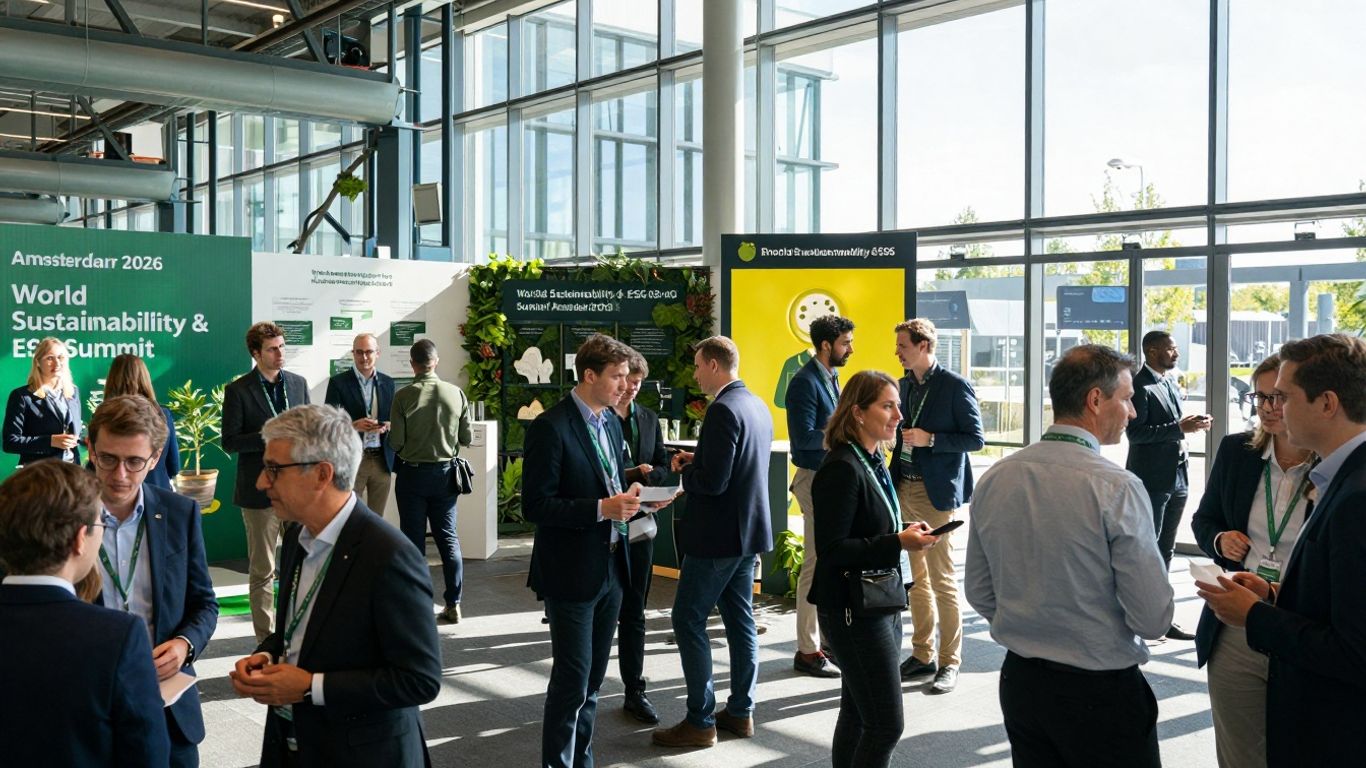
This year's summit in Amsterdam is really shaping up to be a place where important connections happen. It's not just about listening to talks; it's about meeting the people who are actually making things happen. Think investors looking for the next big green idea, policymakers trying to figure out the best rules, and fellow professionals all trying to solve similar problems. The real magic happens in the conversations you have between sessions.
Networking Opportunities with Investors and Policymakers
Getting face-to-face time with investors and policymakers is a big deal. These are the folks who can greenlight projects or shape the regulations that affect everyone. The summit is set up to make these interactions easier. You'll find dedicated networking breaks, but honestly, bumping into someone at the coffee station can be just as productive. It’s a chance to pitch your ideas, understand their priorities, and maybe even find funding or support.
Collaborations for Driving Positive Change
It's tough to tackle big sustainability issues alone. That's why this summit is all about sparking collaborations. You'll meet people from different industries and backgrounds, all with a shared goal. Maybe you'll find a partner for a new recycling initiative or team up with a tech company to develop better energy monitoring tools. The goal is to move beyond just talking and start doing things together.
Benchmarking Approaches for Long-Term Value Creation
How do you know if your sustainability efforts are actually working and adding value? This summit provides a space to compare notes. You can learn from companies that are already ahead of the curve. What metrics are they using? What challenges did they face, and how did they overcome them? Understanding how others are measuring success helps you refine your own strategy for creating lasting value, not just for the planet, but for your business too.
The summit isn't just a conference; it's a marketplace of ideas and partnerships. The connections made here can lead to tangible projects and policy shifts long after the event concludes. It's about building a network that actively works towards a more sustainable future.
The World Sustainability & ESG Summit in Amsterdam was a fantastic place to connect with leaders in the field. We had great conversations about making a real difference. Want to learn more about how we can help your business grow sustainably? Visit our website today!
Looking Ahead: Amsterdam 2026 and Beyond
So, the World Sustainability & ESG Summit 2026 in Amsterdam wrapped up, and it really felt like a turning point. We heard from so many smart people about how we can actually make a difference, not just talk about it. It wasn't just about big ideas; it was about practical steps companies can take right now. From new ways to handle data to making supply chains greener, there were tons of takeaways. It’s clear that sustainability and ESG aren't just trends anymore; they're becoming how business gets done. Leaving Amsterdam, there’s a real sense of optimism that we can build a better future, and events like this are key to making that happen.
Frequently Asked Questions
What is the main goal of the World Sustainability & ESG Summit Amsterdam 2026?
The summit aims to bring together leaders and experts to talk about new ideas and solutions for making our world more sustainable and ensuring businesses act responsibly towards the environment and society. It's all about finding better ways to do things for the future.
Who usually attends this summit?
You'll find many important people there, like business leaders, government officials, investors who care about sustainability, and people who work in the field of environmental and social responsibility. It's a place where key players meet to share knowledge.
What kind of topics will be discussed?
The discussions will cover a lot of ground, such as how companies can be more sustainable and perform better, ways to create a fairer world, how to make sure products are made ethically, and new ideas in clean energy and the circular economy. They'll also talk about how technology like AI can help.
How can attending this summit help my business or organization?
By attending, you can learn about the latest trends, connect with other professionals and potential partners, and discover practical strategies to make your business more sustainable and responsible. It's a great way to get new ideas and build important relationships.
Will there be opportunities to connect with others?
Absolutely! Networking is a big part of the summit. You'll have chances to meet and talk with investors, policymakers, and other leaders. These connections can lead to new collaborations and help drive positive changes.
What does ESG stand for and why is it important?
ESG stands for Environmental, Social, and Governance. It's a way to look at how responsible a company is. 'Environmental' looks at how a company affects the planet, 'Social' looks at how it treats people and communities, and 'Governance' looks at how it's run. Investors and customers increasingly care about these factors when deciding where to put their money or what to buy.