
Top 7 GHG Reporting Software Platforms In 2026
.jpeg)
Greenhouse gas reporting has moved from a voluntary best practice to a regulatory obligation for businesses operating across major economies. With frameworks like CSRD, TCFD, GHG Protocol, and SEC climate disclosure rules now shaping how organizations account for and communicate their emissions, the pressure to get GHG reporting right has never been higher.
For most companies, the challenge is not just measuring emissions, it is doing so accurately, consistently, and in a way that satisfies auditors, investors, and regulators simultaneously.
This is where choosing the right GHG Reporting Software becomes a critical business decision.
The best GHG Reporting Software does far more than generate a carbon number. It should handle data collection across Scope 1, 2, and 3 emissions, apply recognized emission factors automatically, map outputs to multiple reporting frameworks, and maintain the audit trails needed for external assurance.
A platform that delivers on all of these makes GHG reporting a structured, repeatable process rather than an annual scramble.
Let's look at the seven strongest GHG Reporting Software platforms available in 2026 and what sets each one apart.
The 7 Best GHG Reporting Software Platforms: A Quick Overview
Top 7 GHG Reporting Software In 2026
1. Breathe ESG
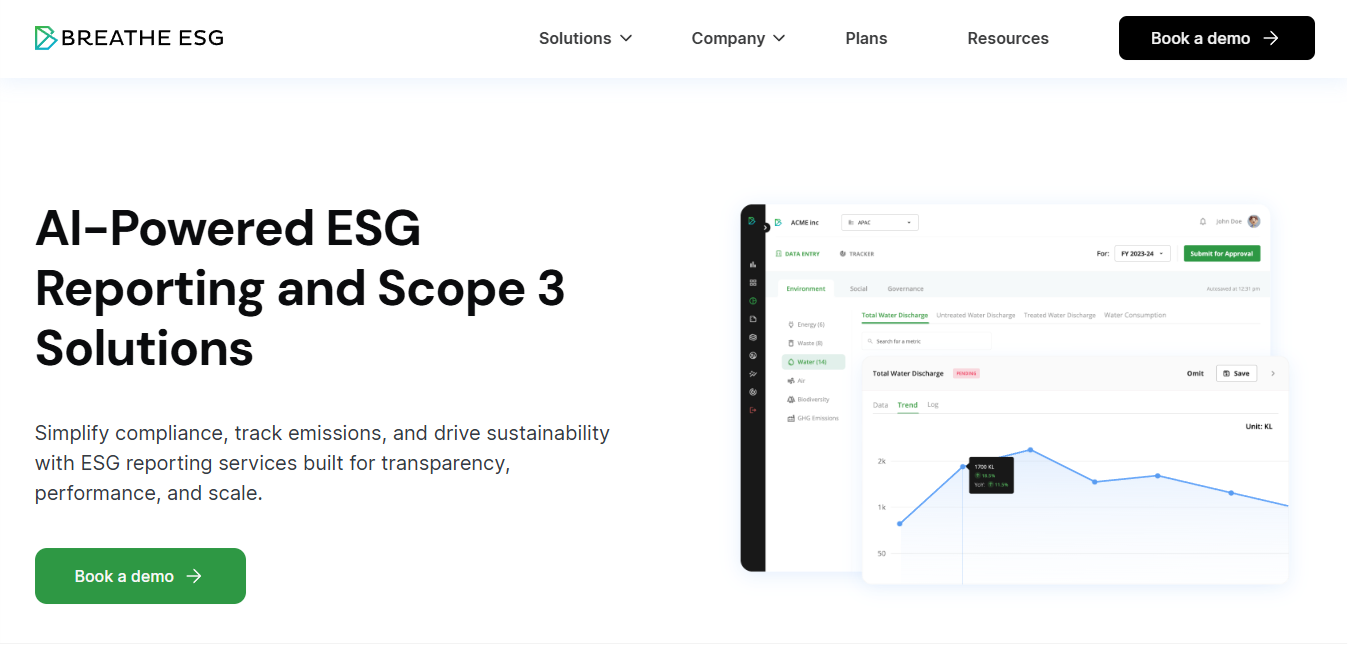
At a time when GHG Reporting Software obligations are tightening across every major regulatory jurisdiction, Breathe ESG offers organizations a single connected platform built to make greenhouse gas accounting accurate, auditable, and actionable.
Founded in 2022 and headquartered in Bengaluru, India, Breathe ESG was designed specifically for companies that struggle to manage GHG data across multiple systems, entities, and frameworks.
Its dedicated solution, Breathe Zero, addresses the full arc of GHG management, from establishing a credible emissions baseline to tracking reduction progress and producing multi-framework disclosures.
For organizations that need GHG reporting to hold up to regulatory, investor, and assurance scrutiny, Breathe ESG brings that entire process into one structured environment.
Key Features
- Automated GHG data ingestion: Connects to utility meters, ERP systems, fleet logs, and procurement data to pull Scope 1, 2, and 3 activity data automatically, building a complete and continuously updated GHG inventory without manual data chasing.
- Built-in emission factor libraries: Pre-loads GHG Protocol-aligned emission factors across hundreds of activity categories, enabling consistent CO₂e calculations without sustainability teams needing to manually source or verify conversion factors.
- Scope 3 supplier engagement portal: A dedicated module enables structured outreach to upstream and downstream suppliers, collecting category-level GHG data through surveys and workflows that make Scope 3 inventory compilation measurably more accurate and scalable.
- GHG inventory dashboards and live tracking: Real-time dashboards visualize emissions by Scope, category, entity, and time period, giving sustainability teams and leadership clear visibility into inventory progress and anomalies before they affect disclosure quality.
- Multi-framework GHG reporting suite: Generates structured disclosures aligned to CDP, GRI, TCFD, CSRD, and BRSR from a single underlying dataset, with full audit trails and documentation to support third-party assurance and investor reporting.
Testimonials
CEOs talk about how Breathe ESG streamlined their sustainability processes, enabling more informed and strategic business decisions. The platform's intuitive design and expert-backed approach simplified ESG workflows, made reporting far more efficient, and gave leadership teams the clarity needed to make better, data-informed decisions.
Senior executives also praise the platform's deep understanding of global ESG recording mechanisms and its customisable dashboards that deliver invaluable oversight and in-depth data analysis, making it a recommended partner for any business serious about GHG reporting.
2. Watershed
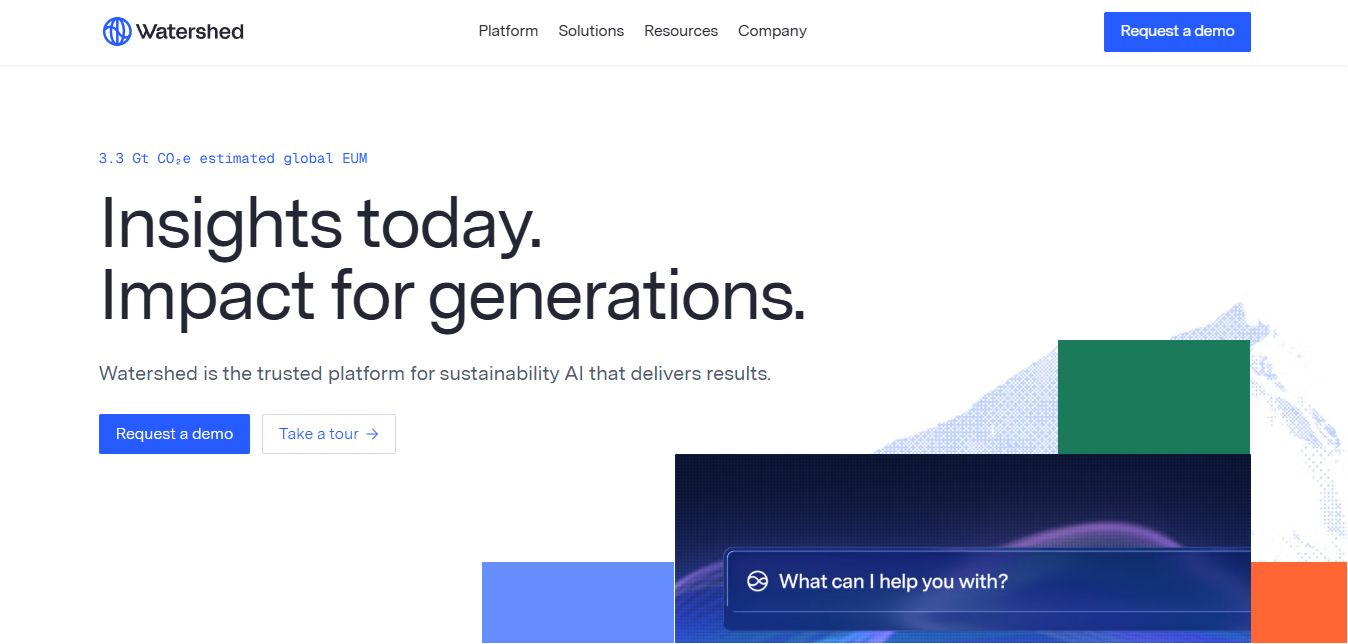
Founded in 2019 and headquartered in San Francisco, Watershed serves organizations that have moved past the question of whether to measure emissions and are now focused on how to measure them with enough rigor to satisfy auditors, regulators, and sustainability-focused investors.
For large enterprises where GHG Reporting Software must translate directly into business decisions, Watershed offers a purpose-built sustainability AI platform that connects emissions data to procurement choices, supplier relationships, and investor-grade disclosures.
The platform approaches GHG reporting not as a compliance tool but as a strategic business intelligence layer, built around the reality that most corporate emissions sit in supply chains rather than direct operations, and that closing that data gap requires precision, not just software deployment.
Key Features
- Supplier engagement workflows: Built-in portals, scorecards, and automated follow-up that help organizations scale supplier outreach and track GHG data collection across the full value chain without manual chasing.
- Audit-ready GHG measurement: Granular Scope 1, 2, and 3 accounting backed by transparent data lineage, supporting GHG figures credible enough to withstand external verification and multi-framework regulatory scrutiny.
- AI-powered product footprints: Product-level GHG intelligence that maps specific procurement decisions to emission outcomes, enabling organizations to identify and act on the highest-impact reduction levers across their supply chain.
Testimonials
Enterprise reviewers on G2 describe how Watershed cut their carbon footprinting process from several months down to just weeks, removing the complexity of spreadsheet-based calculations and giving sustainability teams far more time to focus on actual reduction work.
Reviewers on G2 also highlight how the platform significantly improved their audit readiness, providing a reliable and credible system that replaced error-prone manual processes and gave internal stakeholders greater confidence in reported emissions over time.
3. Greenly
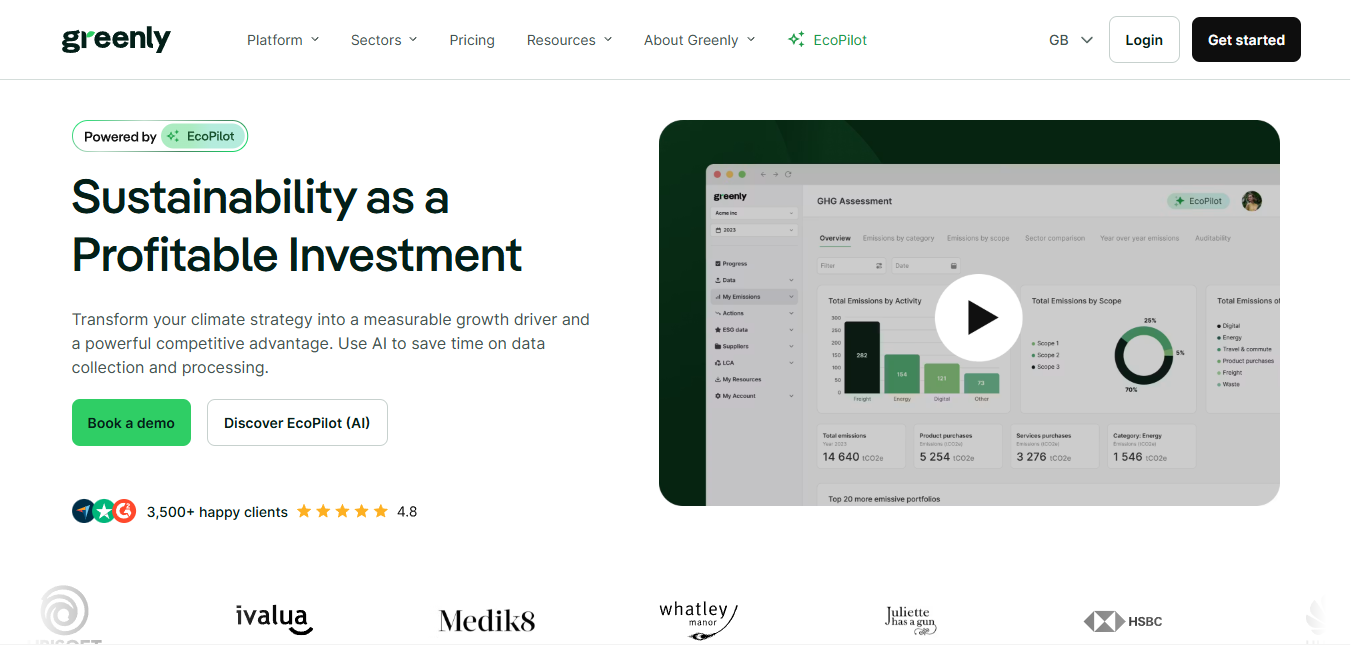
What started as a consumer carbon footprint application in 2019 has quietly become one of the most widely adopted GHG Reporting Software platforms globally.
Greenly, headquartered in Paris, now serves more than 3,500 organizations across industries, from mid-sized businesses filing their first GHG inventory to large multinationals managing complex Scope 3 disclosures.
The platform's growth reflects a deliberate positioning choice: make enterprise-grade GHG reporting genuinely accessible, not just in terms of price transparency, but in how the product is experienced day to day.
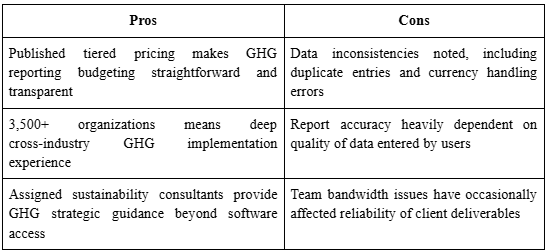
Greenly pairs AI automation with a dedicated sustainability consultant assigned to every client, so organizations get both the technology to handle GHG data at scale and the expertise to make sense of what it is telling them.
Key Features
- EcoPilot AI for GHG data automation: Greenly's AI co-pilot automates the ingestion, validation, and modeling of Scope 1, 2, and 3 GHG data, drawing from 300,000+ emission factors to reduce the manual effort that typically slows GHG inventory compilation.
- Lifecycle assessment and product carbon footprinting: Supports full LCA and EPD reporting, giving organizations a detailed view of embedded GHG emissions across products, processes, and supply chains for more precise and defensible disclosure.
- GHG trajectory builders and supplier engagement: Carbon trajectory simulators model how different operational choices affect future GHG totals, while built-in supplier survey workflows gather the value-chain data needed for accurate Scope 3 reporting.
Testimonials
Reviewers on Capterra describe Greenly as genuinely easy to work with, highlighting the platform's intuitive design and the responsiveness of its expert team as key reasons GHG reporting feels significantly more manageable than it did before.
Others on Capterra note that having a dedicated sustainability consultant alongside the platform made a meaningful difference in how confidently their teams approached GHG inventory compilation, supplier data collection, and annual reporting cycles.
4. Persefoni
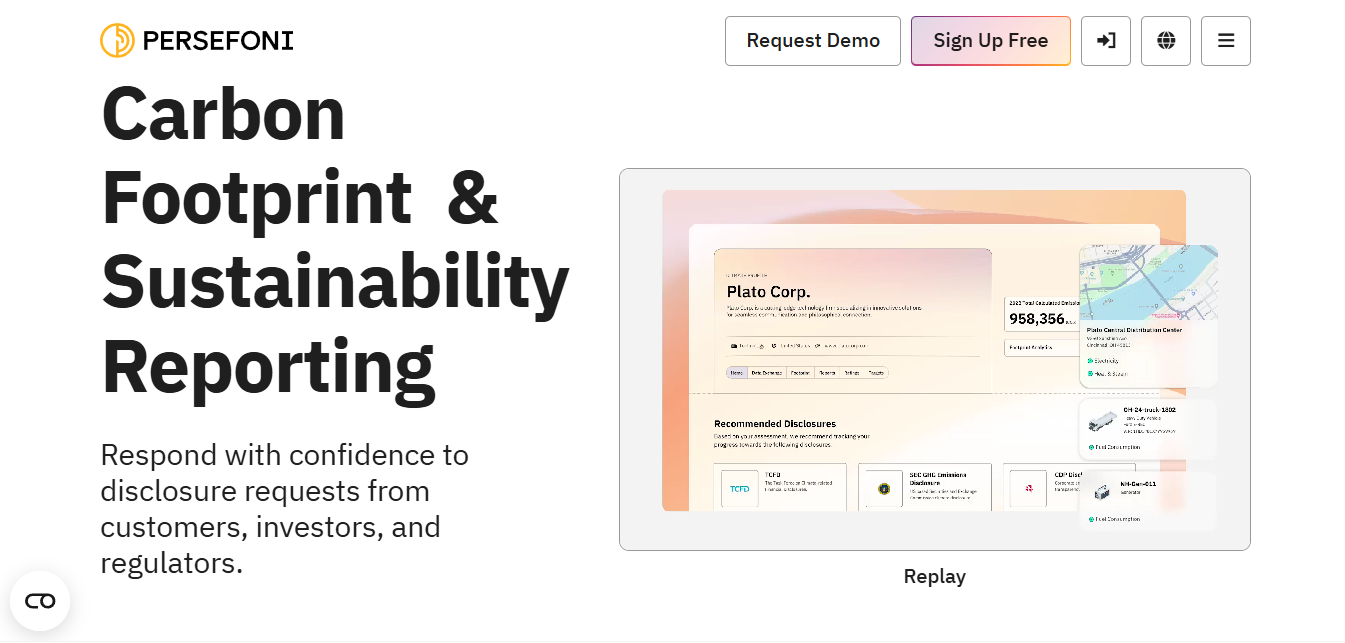
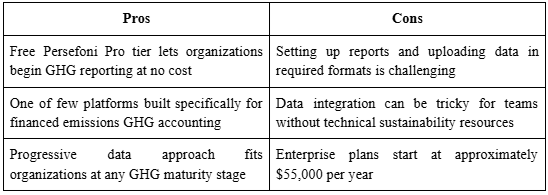
Founded in 2020 and backed by nearly $180 million in funding, Persefoni was built specifically for organizations where GHG Reporting Software cannot exist separately from financial governance. Banks, insurers, and investment managers use it to quantify both operational and financed emissions with the audit-grade confidence that TCFD, PCAF, and CSRD require.
Operating across six countries, Persefoni's approach is rooted in progressive data maturity, meeting organizations where their data is today and building toward more precise, primary-data-driven GHG accounting over successive reporting cycles.
Key Features
- Scenario planning and GHG pathway modeling: Models multiple emissions reduction strategies, helping organizations compare GHG pathways, assess trade-offs, and align climate targets with evolving regulatory, investor, and operational expectations.
- Spend-based to actuals progression: A structured data maturity journey that lets organizations begin GHG reporting with available spend estimates and continuously refine toward supplier-specific and activity-level data as reporting capability develops.
- Finance-grade GHG reporting: Links carbon accounting directly to governance, audit, and investor disclosure workflows, helping organizations produce consistent, traceable GHG data that meets the standards financial stakeholders demand.
Testimonials
Customers on Capterra describe how Persefoni helped their organizations move away from spreadsheet-based GHG management toward a more credible and structured reporting process, with clearer emissions calculations, better data organization, and a workflow that holds up to assurance review.
Reviewers further highlight the value of Persefoni's specialist knowledge in helping teams understand the right GHG methodology for their inventory, build better data collection habits, and improve the transparency of their climate disclosures over time.
5. IBM Envizi
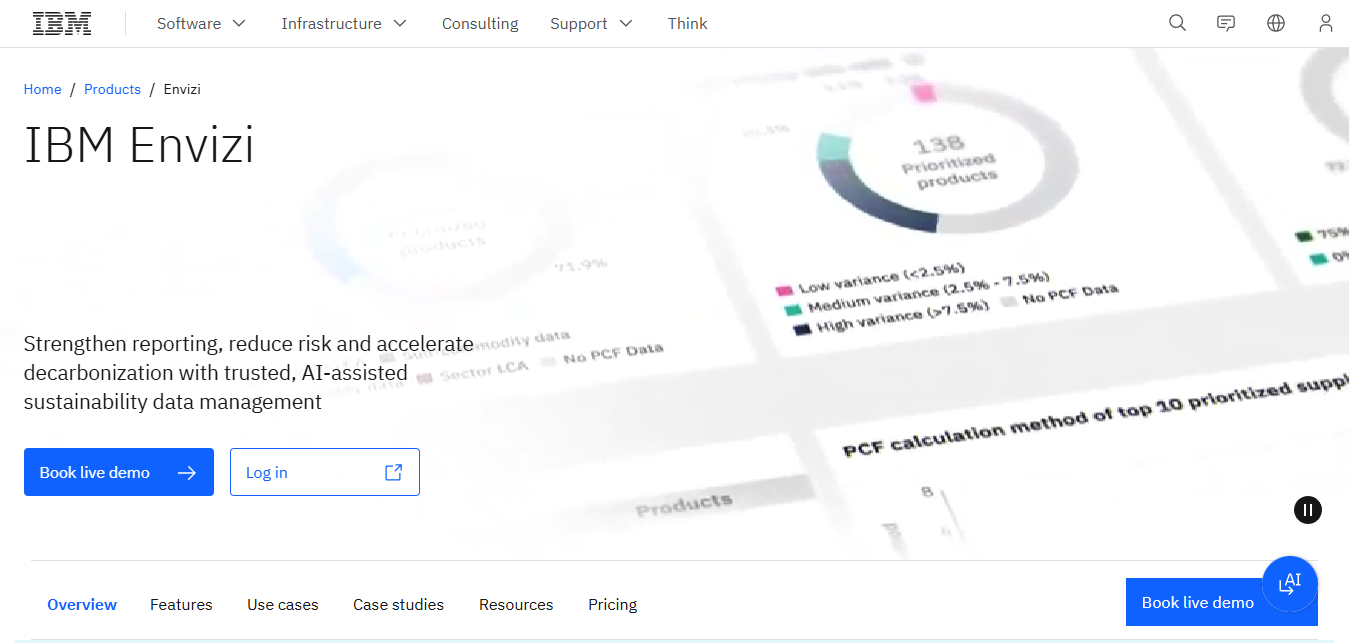
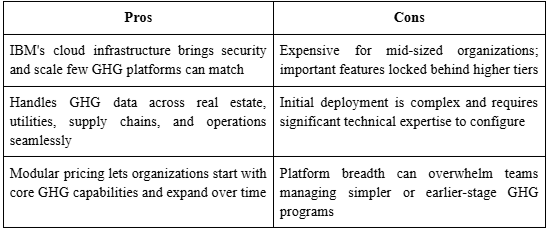
Some sustainability platforms are built around GHG reporting workflows. IBM Envizi is built around the data infrastructure that makes those workflows possible at multinational scale.
Originally developed as Envizi technology since 2004 and acquired by IBM in 2022, the platform brings together the sustainability-specific depth of a purpose-built ESG tool with the security, scalability, and integration capability of IBM's global technology ecosystem.
For organizations managing GHG Reporting Software needs across hundreds of sites, business units, and geographies, that combination addresses a problem most enterprise sustainability programs face: not a lack of reporting frameworks, but an inability to consolidate the underlying data reliably enough to make credible, assured GHG disclosure genuinely achievable at scale.
Key Features
- AI-assisted GHG planning and forecasting: Integrated planning tools model GHG emissions trajectories, test different reduction scenarios, and align decarbonization targets with operational and financial realities to support credible, board-level climate commitments.
- Automated capture of 500+ data types: Connectors, file-loading workflows, and API integrations pull energy, emissions, water, and supply chain data from across the enterprise into one fully auditable GHG system of record.
- Target setting, tracking, and program management: Defines science-based GHG targets, tracks performance against them across sites and business units, and manages the programs designed to close the gap between current trajectory and net-zero commitment.
Testimonials
Users on G2 describe IBM Envizi as a meaningful upgrade from spreadsheet-heavy GHG reporting, praising its ability to centralize sustainability data across complex organizational structures and make the entire reporting process considerably more manageable.
More reviews explain how the platform strengthened their audit readiness and improved GHG data consistency across multiple sites, reducing categorization errors and cutting the time spent on annual reporting cycles significantly.
6. Plan A
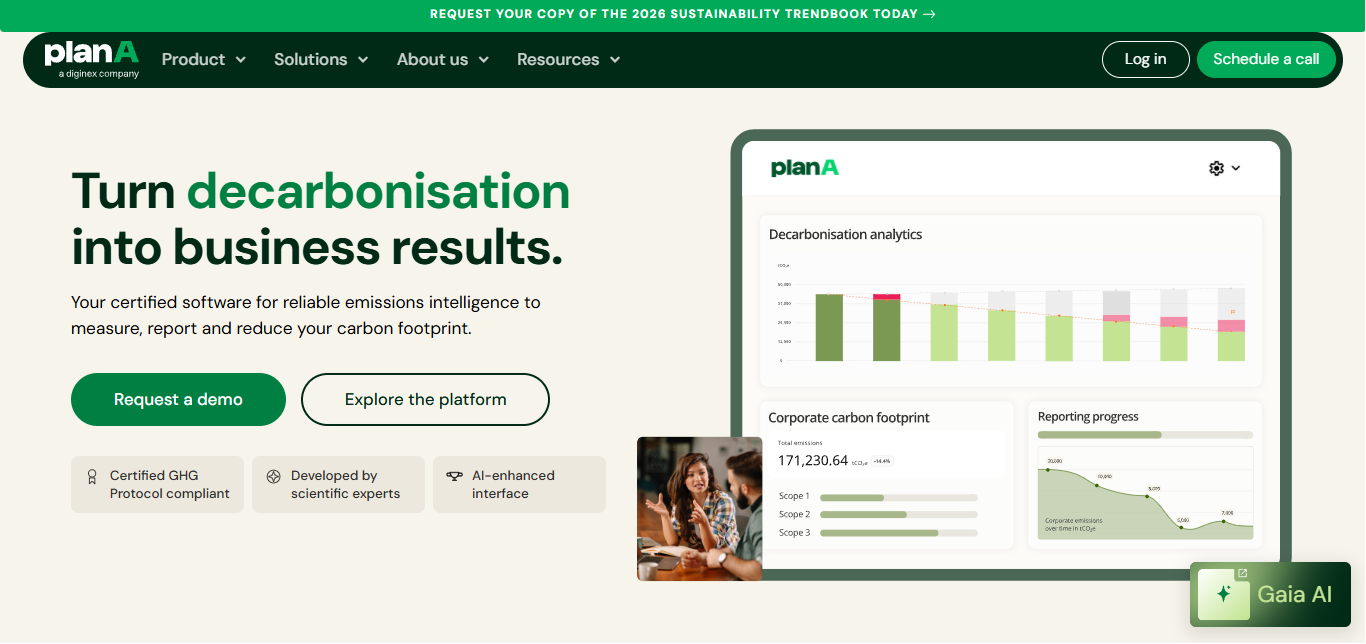
When Plan A was founded in Berlin, it was built around a specific conviction: that GHG Reporting Software should be designed to drive climate action, not just satisfy disclosure requirements.
That philosophy shapes how the platform approaches every client relationship and every reporting cycle.
Today, Plan A serves organizations across Europe and beyond, helping them build credible GHG programs that meet CSRD, ESRS, and science-based target obligations while simultaneously advancing real reduction work.
For sustainability teams without large internal resources, Plan A's combination of intuitive software and dedicated in-house climate expertise makes enterprise-grade GHG reporting accessible in a way that few European platforms have managed to achieve at scale.
Key Features
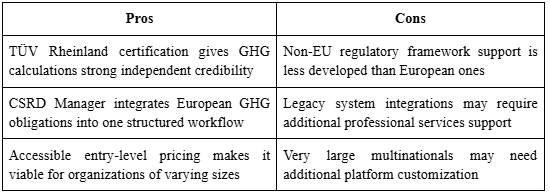
- TÜV-certified GHG methodology engine: Uses GHG Protocol-compliant, TÜV Rheinland-certified calculation methods to produce consistent, defensible GHG inventories that sustainability teams can stand behind during regulatory audits and investor disclosures.
- AI-powered data mapping and anomaly detection: Guides users through GHG data setup, learns organizational conventions, flags inconsistencies automatically, and bridges raw inputs to ESRS and GHG disclosure outputs without requiring manual mapping between systems.
- Science-based target alignment and GHG reduction roadmaps: Converts GHG baseline results into prioritized, time-bound reduction plans with clear ownership, connecting disclosure outputs directly to the operational changes needed to meet net-zero commitments.
Testimonials
Verified reviewers on Capterra give Plan A a 4 out of 5, describing it as a platform that delivers on its core GHG reporting capability while noting that the interface can be complex to navigate as the product continues to evolve.
Organizations featured on Plan A's website further highlight significant efficiency gains in GHG data management, with sustainability teams reporting up to 80% reductions in time spent on data entry and much clearer visibility into their emissions performance.
7. Normative
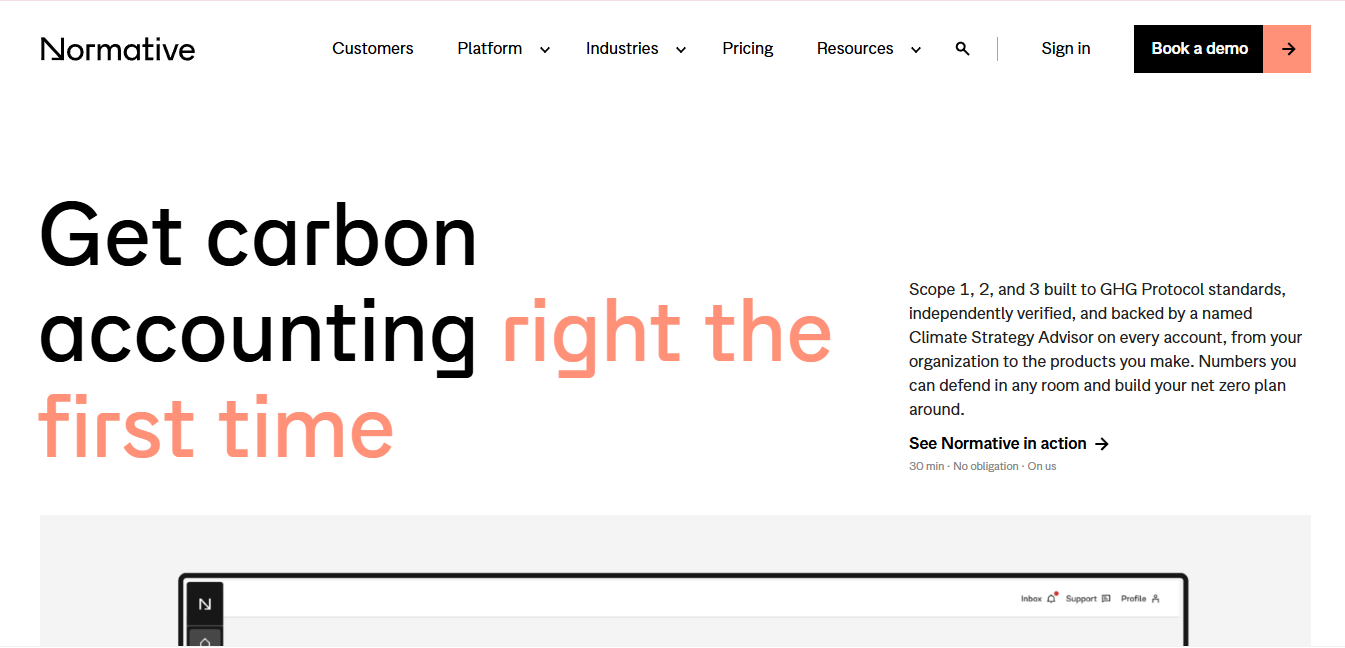
Normative was founded in Stockholm in 2014 on exactly the principle of building a carbon accounting platform where independent verification, not just software functionality, sits at the center of the offering.
With offices in Stockholm, Copenhagen, and London, Normative serves European enterprises across financial services, manufacturing, and technology that need GHG Reporting Software they can stand behind in regulatory filings, investor conversations, and external assurance engagements.
It combines robust GHG calculation infrastructure with embedded climate strategy expertise, making it a strong fit for organizations that want both methodological credibility and ongoing strategic guidance from the same partner rather than sourcing the two separately.
Key Features
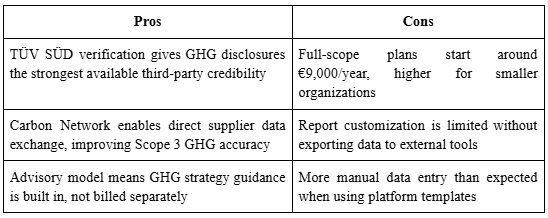
- TÜV SÜD-verified GHG accounting: GHG Protocol-aligned emissions calculations independently verified by TÜV SÜD, providing the level of methodological credibility that net-zero claims, regulatory filings, and external assurance engagements increasingly demand from organizations.
- Dedicated climate strategy advisor: Every account includes a named GHG Protocol-certified advisor who understands the organization's data, sector context, and methodology, adding strategic guidance that goes beyond software access alone.
- Supplier data ecosystem and carbon network: Direct connections to Carbon Network and EcoVadis enable primary supplier data collection, strengthening Scope 3 GHG accuracy and reducing reliance on spend-based estimates across the value chain.
Testimonials
Reviewers on Capterra describe Normative as having fundamentally changed how their organizations approach GHG accounting, shifting from time-consuming annual spreadsheet processes to a more continuous and structured quarterly reporting cycle with greater accuracy and confidence.
Others further highlight the value of Normative's GHG Protocol-certified advisors in providing strategic guidance that goes beyond what a pure software platform can offer, particularly when handling detailed Scope 3 inventories.
How To Choose The Right GHG Reporting Software?
1. Confirm the platform covers all three scopes natively.
Not all GHG Reporting Software is built equally when it comes to Scope coverage. Some platforms handle Scope 1 and 2 well but treat Scope 3 as an add-on or afterthought.
Before committing, confirm that the platform supports all fifteen Scope 3 categories, offers supplier engagement tools for primary data collection, and applies recognized emission factors consistently across all scopes.
For most organizations, Scope 3 represents the majority of their GHG footprint, and a platform that cannot handle it rigorously cannot handle GHG reporting rigorously.
2. Prioritize GHG Protocol alignment and assurance-readiness from day one.
GHG reporting is increasingly subject to external assurance requirements, particularly under CSRD reporting and investor-driven disclosure frameworks. The platform you choose should apply GHG Protocol-aligned methodology, maintain full audit trails, and produce documentation that external verifiers can follow without friction.
Choosing a platform with assurance readiness built in from the start is far less disruptive than retrofitting it later when regulatory deadlines arrive. Breathe ESG, Persefoni, and Normative each prioritize this by design.
3. Consider how much expert support you need alongside the software.
For organizations earlier in their GHG reporting journey, software alone is rarely enough. Platforms like Breathe ESG, Normative, and Plan A offer expert guidance embedded into the engagement, meaning sustainability teams get strategic support alongside the technology rather than just a login and a help center.
The right GHG Reporting Software for your organization is the one that matches both your technical requirements and the level of human support your team needs to produce credible disclosures year after year.

How GHG Reporting Software Strengthens Climate Disclosure
Good GHG Reporting Software does more than produce and track a carbon number. It builds the data infrastructure, calculation rigor, and documentation trail that transforms a sustainability team's output from an internal estimate into a credible, externally verifiable disclosure.
That shift matters enormously as regulators, investors, and assurance providers raise their expectations for what a GHG report needs to demonstrate.
Organizations that rely on spreadsheet-based GHG accounting typically face the same set of problems: inconsistent emission factors applied across different reporting years, Scope 3 data gaps that undermine inventory completeness, manual aggregation errors that surface during assurance reviews, and annual reporting cycles that consume more resources than the disclosure itself justifies.
The right GHG Reporting Software eliminates each of those problems systematically.
The best reporting platforms on this list also share a commitment to continuous improvement. GHG reporting is not a static process. Frameworks evolve, new regulatory requirements emerge, and an organization's data quality improves as supplier relationships and internal processes mature.
A platform that grows with that journey rather than one that only handles a first-year submission is the one that creates durable, long-term value for sustainability teams.

Strengthen Your GHG Reporting With Breathe ESG
Each of the platforms covered in this guide brings something meaningful to the GHG reporting challenge. Whether that is supply-chain data intelligence, finance-grade accounting, European regulatory alignment, or independently verified methodology, there is a strong option on this list for organizations at every stage of their journey.
Breathe ESG remains as a priority because it combines all the essentials including Scope 1, 2, and 3 coverage, GHG Protocol-aligned calculations, multi-framework disclosure outputs, and real-time performance tracking, in a single platform that is both enterprise-capable and genuinely accessible.
It is built for organizations that need GHG Reporting Software to be rigorous, repeatable, and directly connected to the reduction work that follows from it.
For teams that want a platform that grows with their program, connects reporting to action, and holds up to the scrutiny of regulators and investors alike, Breathe ESG is the place to start.
Book a discovery call today to see how Breathe ESG can transform your GHG reporting program.
FAQs
What is GHG software?
GHG software is a digital platform that helps organizations measure, manage, and report their greenhouse gas emissions. It automates data collection, applies recognized emission factors, and generates disclosures aligned to frameworks like GHG Protocol, CDP, and CSRD.
What is the software for GHG calculation?
GHG calculation software applies emission factors to activity data such as energy use, fuel consumption, and procurement spend to calculate CO₂e emissions across all three scopes. Dedicated platforms handle this more accurately and consistently than spreadsheet-based calculations ever can.
How to do GHG reporting?
GHG reporting involves collecting activity data across Scope 1, 2, and 3 emissions, applying GHG Protocol-aligned emission factors, and producing disclosures aligned to relevant frameworks such as CDP, TCFD, or CSRD. A dedicated GHG reporting platform automates and structures this entire process from end to end.
What's the best tool for carbon footprint reporting?
Breathe ESG is one of the strongest tools for carbon footprint reporting. It combines automated Scope 1, 2, and 3 data collection, multi-framework outputs, and real-time dashboards in one connected platform, making it accessible and enterprise-ready for organizations at any reporting stage.