
Explore Stunning Watershed Graphic Designs for Your Next Project
Creating a visual representation of a watershed can be a really cool project. It's not just about drawing pretty pictures; it's about showing how everything connects. Think about a river, the land around it, and how people interact with it. Graphic design can help tell that story in a way that's easy to understand and memorable. We're going to look at how some folks tackled this, turning complex ideas about water and land into a striking watershed graphic.
Key Takeaways
- Visual storytelling is a powerful way to explain watershed concepts. Using graphics helps make environmental ideas clear and engaging.
- Translating complex environmental themes into simple, compelling images is possible with good design. A strong watershed graphic can communicate a lot.
- Collaboration is key. When different people bring their skills together, the final watershed graphic project can be much stronger.
- Scaling up a design, like for a mural, requires planning. Using grids and involving others can make the process manageable and successful.
- Artistic teamwork can create something amazing. When artists blend their styles, the resulting watershed graphic has more depth and impact, building confidence for everyone involved.
Capturing Watershed Concepts Through Graphic Art
Graphic art offers a really powerful way to get complex ideas about watersheds across to people. It's not just about pretty pictures; it's about telling a story visually. Think about it – a well-designed graphic can explain how water flows, why it's important, and what threats it faces, all at a glance. This visual storytelling is key when you're trying to get people to care about environmental issues.
The Power of Visual Storytelling in Watershed Graphics
When we talk about watersheds, we're dealing with interconnected systems. Water moves, it shapes the land, and it supports life. Translating this dynamic process into a static image can be tricky, but that's where graphic design shines. A good graphic can simplify complex ecological relationships, making them understandable to a wide audience. It can highlight the journey of water from its source to the sea, showing how actions in one area affect another. This kind of visual narrative helps people connect with the environment on a more personal level.
Translating Environmental Themes into Compelling Imagery
Getting environmental themes into graphics means finding symbols and styles that speak to the core message. For instance, showing the contrast between a healthy, natural landscape and a polluted urban one can be very effective. The idea is to create imagery that is not only informative but also emotionally engaging. It might involve using specific color palettes to represent water quality or depicting local flora and fauna to emphasize biodiversity. The goal is to make the abstract concept of a watershed feel tangible and relevant to everyday life. This approach can be seen in various environmental initiatives, like those focused on carbon accounting and climate disclosures, where clear visuals are needed to communicate data and impact.
The Role of Collaboration in Watershed Graphic Design
Often, the most impactful watershed graphics come from teamwork. Bringing together artists, environmental experts, and community members can lead to designs that are both accurate and deeply meaningful. This collaborative process allows for different perspectives to be shared, resulting in a richer, more nuanced final product. It's about combining skills and ideas to create something greater than any one person could achieve alone. This synergy is what makes projects like murals so successful, turning a shared vision into a vibrant reality.
Collaboration ensures that the final artwork accurately reflects the community's connection to its watershed and the shared responsibility for its health. It moves beyond a single artist's interpretation to a collective expression of stewardship.
Designing a Meaningful Watershed Graphic Mural
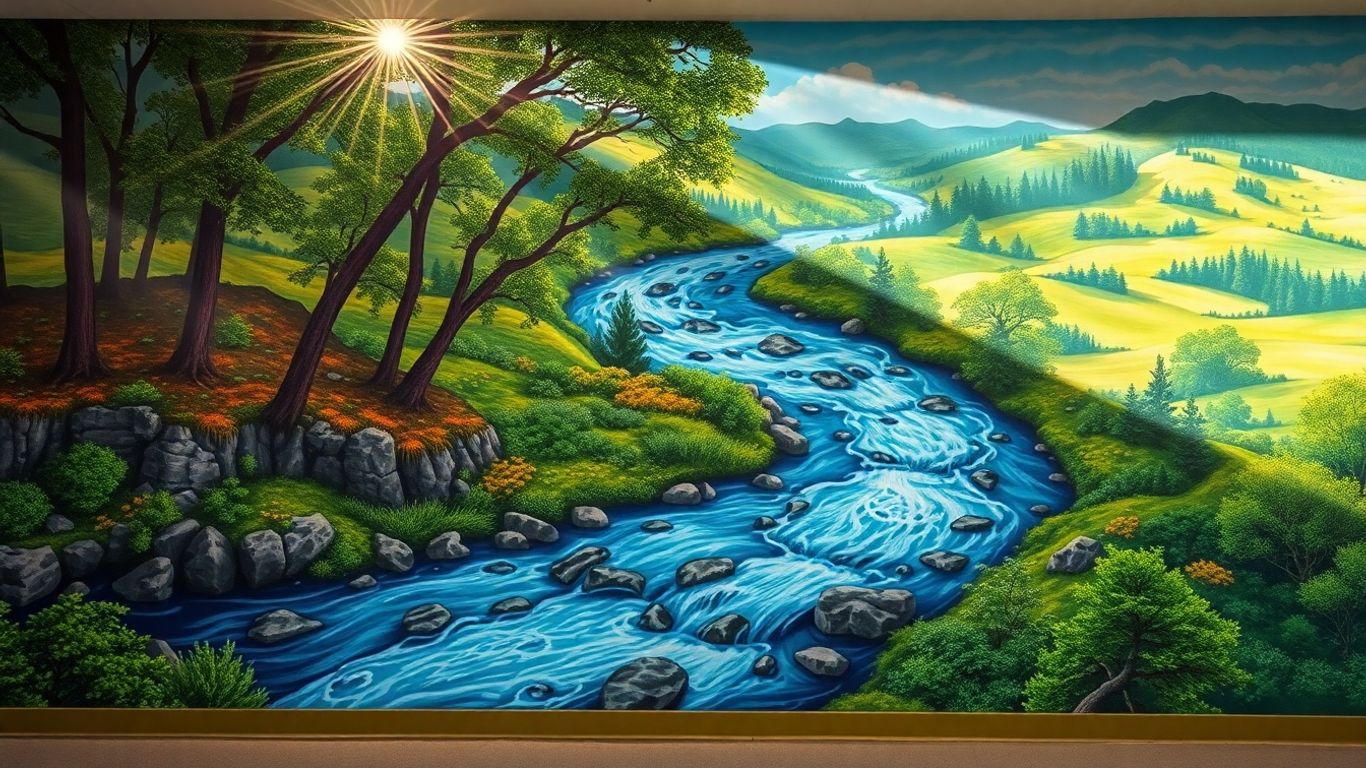
Creating a mural that speaks to watershed concepts is more than just putting paint on a wall; it's about telling a story that connects people to their environment. This process involves careful planning and a collaborative spirit to bring a vision to life.
From Concept to Canvas: The Design Process
The journey from an idea to a finished mural is often a winding one, but incredibly rewarding. It starts with understanding the core message you want to convey about the watershed. For us, the idea of stewardship really took hold. The image of hands gently holding water became the central theme, symbolizing our role in protecting these vital resources. This simple yet powerful visual immediately made sense.
Here's a general flow for developing the design:
- Brainstorming Core Themes: What aspects of the watershed are most important to highlight? (e.g., water quality, wildlife, community involvement, pollution, restoration).
- Sketching Initial Concepts: Translating those themes into visual ideas. Don't be afraid to explore different styles and compositions.
- Developing a Central Image: Finding a focal point that encapsulates the main message. The hands-cupping-water idea was a breakthrough for us.
- Refining the Design: Adding details and ensuring the overall composition is balanced and impactful.
The initial concept often evolves through discussion and shared input. What might seem like a small suggestion can lead to a significant improvement in the final design, making it more relatable and powerful.
Incorporating Natural and Urban Elements in Watershed Art
Watersheds aren't just pristine natural landscapes; they are often complex environments where nature meets the built world. A compelling mural should reflect this reality. We decided to show the contrast between a natural setting and a cityscape. This juxtaposition highlights how different environments are connected by the same water systems and how our actions in urban areas directly impact natural ecosystems. It’s about showing that the watershed is everywhere, not just in the woods.
The Symbolism of Hands in Watershed Graphic Design
Hands are incredibly versatile symbols. In the context of watershed art, they can represent:
- Stewardship and Care: Actively protecting and nurturing water resources.
- Connection: Linking human activity to the health of the watershed.
- Action: The physical work involved in restoration and conservation.
- Responsibility: Our collective duty to manage water wisely.
Using hands in a mural can make the message very personal and direct, inviting viewers to consider their own role. It’s a way to visually communicate that the future of our watersheds is quite literally in our hands. This approach can be a great way to get community buy-in for watershed projects.
Scaling Up and Executing Your Watershed Graphic Project
Grid Techniques for Large-Scale Mural Art
So, you've got a killer design concept for your watershed mural. Awesome! But how do you get that small sketch onto a giant wall or, in our case, a cargo container? That's where the trusty grid method comes in. It's like a secret weapon for artists tackling big projects. Basically, you draw a grid over your original design. Then, you draw a matching, but much larger, grid on the surface you're painting. Each square on the big grid corresponds to a square on the small one. This helps you transfer the image section by section, making sure everything stays in proportion. It sounds simple, and it is, but it takes patience.
Here's a quick rundown:
- Measure and Mark: Carefully measure your mural surface and divide it into equal squares. The size of these squares depends on how big your original drawing is and how big your final piece will be. For our container, we went from 1-inch squares on paper to 1-foot squares on the wall.
- Transfer the Lines: Use chalk or a light pencil to draw the grid lines onto your surface. Make sure they're straight and evenly spaced.
- Draw Square by Square: Now, focus on one small square from your original design. Recreate what's in that square within the corresponding large square on your mural surface. It's like connecting the dots, but on a grand scale.
- Connect and Refine: Once all the squares are filled in, you'll have a complete outline of your design on the mural surface. Then, you can go over the grid lines and start refining the details.
The Painting Process: From Sketch to Finished Piece
With the grid in place and the outline sketched, the real fun begins: painting! This is where your design truly comes to life. It’s a process that requires focus, a steady hand, and a willingness to experiment. Don't be afraid to mix colors right on the wall or try different brush strokes to achieve the look you want. The key is to work methodically, building up layers and details gradually. Remember that initial nervousness? It fades as you get into the rhythm of painting. Each stroke builds confidence, and soon you'll be making decisions about color and detail like a pro.
Engaging Interns and Community in Graphic Projects
Big graphic projects aren't just about the art; they're also about the people involved. Bringing interns and community members into the process can be incredibly rewarding. It's a chance for them to learn new skills, contribute to something meaningful, and feel a sense of ownership. We found that once the painting started, other interns and staff were eager to jump in. Music, sunshine, and a shared goal made for a really positive atmosphere. It’s amazing how working together on a project like this can build connections and strengthen a community's commitment to its environment. Plus, seeing the finished piece, knowing you had a hand in it, is a pretty great feeling for everyone involved.
When you involve others, especially young people, in a hands-on art project tied to environmental themes, you're not just creating a mural. You're building skills, fostering a connection to place, and inspiring a new generation of stewards. It's a powerful way to communicate complex ideas visually and create lasting impact.
Artistic Synergy in Watershed Graphic Creation
Blending Distinct Artistic Styles for a Unified Vision
Sometimes, a project benefits from more than one creative mind. When you bring together artists with different backgrounds and ways of seeing things, you can get something really special. It’s like mixing different colors to make a new shade you wouldn’t have thought of on your own. For our watershed mural, we had two main artists, Jeremiah and Jimena, each with their own style. Jeremiah leaned towards urban scenes, while Jimena captured the natural world. The goal was to make these two worlds meet in the middle, showing how they're connected.
The Impact of Multiple Artists on a Watershed Graphic
Having more than one artist means more ideas and more hands to get the work done. It can also mean a richer final piece. Think about it: one artist might be great at drawing buildings, another at painting water. When they work together, the whole picture gets better. We saw this happen when another artist, Echo, joined us. Echo brought a skill for illustration and color that added a whole new layer to the city buildings and other details. This collaboration didn't just add more elements; it deepened the entire visual narrative. It was amazing to see how their individual talents combined to create a cohesive image.
Building Confidence Through Collaborative Art Projects
Working with others on a big art project can be a bit nerve-wracking at first. You might worry about your part fitting in or if your ideas are good enough. But as you work through it, you start to trust yourself and your teammates. We saw our interns, Jeremiah and Jimena, grow a lot. They started out feeling unsure, but as they painted and made decisions about colors and details, they became more confident. They learned to trust their own abilities and each other's. It’s a great feeling when you realize you’ve created something awesome together that’s even better than what any one person could have done alone.
Working together on a project like this teaches you that everyone has something unique to contribute. It’s not about being the best artist, but about how your skills fit with others to make a bigger picture. This shared effort builds a stronger sense of community and accomplishment.
Here's a look at how the different styles came together:
Inspiring Future Watershed Graphic Initiatives
Lessons Learned from a Successful Watershed Mural
Looking back at the "Life in Our Hands" mural project, it's clear that collaborative art can be a powerful tool for environmental awareness. The process itself taught us so much. We learned how to build a rainwater harvesting system, which was a practical skill for the interns. But beyond that, we saw how art could bring people together and communicate complex ideas about watershed health. The synergy created when distinct artistic styles blended into a unified vision was truly remarkable. It showed that even with different backgrounds and skills, a shared goal can lead to something greater than the sum of its parts.
The Potential for Future Graphic Art Projects
This project has definitely opened our eyes to the possibilities. Imagine more murals like this, not just on storage containers, but on community centers, schools, and public buildings. Each one could tell a unique story about its local watershed, highlighting specific challenges and successes. We could even incorporate interactive elements or use augmented reality to bring the art to life. The key is to keep the design process accessible and involve the community at every step. It's about more than just pretty pictures; it's about building a connection to our environment. For organizations looking to manage their environmental impact, platforms like IBM Envizi offer tools for tracking sustainability data, which could complement the visual storytelling of these art projects.
Empowering Communities Through Environmental Art
What we saw with the Green Collars Corps interns was a real boost in confidence. They started out nervous, unsure of their abilities, but by the end, they were making decisions, mixing colors, and taking ownership of their work. This kind of hands-on experience is invaluable. It builds leadership skills and a sense of pride in their community and its natural resources. Future projects should aim to replicate this. We can involve more young people, partner with local schools, and make sure the art reflects the specific character and needs of each watershed. It's about creating a visual legacy that inspires ongoing stewardship and action.
Here are some key takeaways for planning future initiatives:
- Community Involvement: Always bring local residents and potential stakeholders into the design and painting process early on.
- Skill Building: Integrate educational components that teach practical environmental skills alongside artistic ones.
- Storytelling Focus: Ensure the artwork clearly communicates the unique environmental narrative of the specific watershed.
- Accessibility: Design projects that can be adapted to different scales and budgets, making them achievable for various groups.
The most impactful projects are those that not only beautify a space but also educate and inspire action. When people see their environment represented artistically and understand the human connection to it, they are more likely to become active participants in its protection. This kind of art becomes a constant, visible reminder of our shared responsibility.
Want to help shape the future of watershed projects with cool graphics? We're looking for creative minds to join our "Inspiring Future Watershed Graphic Initiatives." Let's make environmental data easy to understand and visually appealing together. Visit our website to learn more and see how you can get involved!
Wrapping It Up
So, we've looked at some really cool ways graphic design can show off watershed stuff. It's pretty neat how a good image can explain complex ideas, right? Whether it's a mural on a container or a simple graphic, it makes you think about our water and how we take care of it. Hopefully, seeing these examples gives you some ideas for your own projects. It just goes to show that art and nature can really come together in interesting ways.
Frequently Asked Questions
What is a watershed graphic?
A watershed graphic is like a picture or drawing that tells a story about water and the land around it. It can show how water flows, where it comes from, and how people and nature affect it. Think of it as a visual way to understand our water systems.
Why are watershed graphics important for projects?
These graphics help people understand complex ideas about water and the environment in a simple, visual way. They can make projects more interesting and help everyone involved, from artists to community members, get on the same page about what needs to be done.
How do you turn environmental ideas into a graphic?
It's like translating a story into pictures. Designers look at the main ideas, like how water is protected or how nature and cities work together, and then they use colors, shapes, and images to represent those ideas in a way that's easy to see and understand.
Can multiple artists work on one watershed graphic?
Yes, absolutely! When different artists with their own styles work together, they can create something even more amazing. It's like each artist brings a special ingredient, and when mixed, they make something unique and powerful that's better than what one person could do alone.
How do you make a large watershed graphic, like a mural?
For big projects like murals, artists often use a grid system. They draw a grid on their small design and then a bigger grid on the wall. This helps them copy the design accurately, making sure everything is in the right place, just like connecting the dots on a giant scale.
What's the main message behind the 'Life in Our Hands' mural example?
The 'Life in Our Hands' mural shows that taking care of our water is a shared responsibility. It highlights how both nature and city life depend on water, and that people's actions, like restoring habitats, are key to keeping our water healthy for everyone.