
BRSR Requirements in India: SEBI ESG Reporting Guidelines Explained
.jpeg)
Understanding what is BRSR and its compliance requirements now determines whether your organization meets regulatory deadlines or faces disclosure gaps. These BRSR requirements in India apply as per SEBI’s ESG reporting guidelines.
This guide breaks down BRSR compliance requirements, reporting structure, and implementation steps for Indian companies navigating mandatory ESG reporting India frameworks.
What Is BRSR?
Business Responsibility and Sustainability Reporting (BRSR) is a mandatory ESG reporting framework introduced by SEBI for listed companies in India.
SEBI designed BRSR reporting to align Indian corporate disclosures with global sustainability standards including GRI, UN Global Compact, and UN Sustainable Development Goals.
The framework replaced the Business Responsibility Report (BRR) format, which offered limited quantitative metrics and inconsistent reporting. BRSR explained simply: it requires companies to disclose quantitative and qualitative data across environmental, social, and governance parameters in a standardized format that enables year-over-year comparison and external assurance.
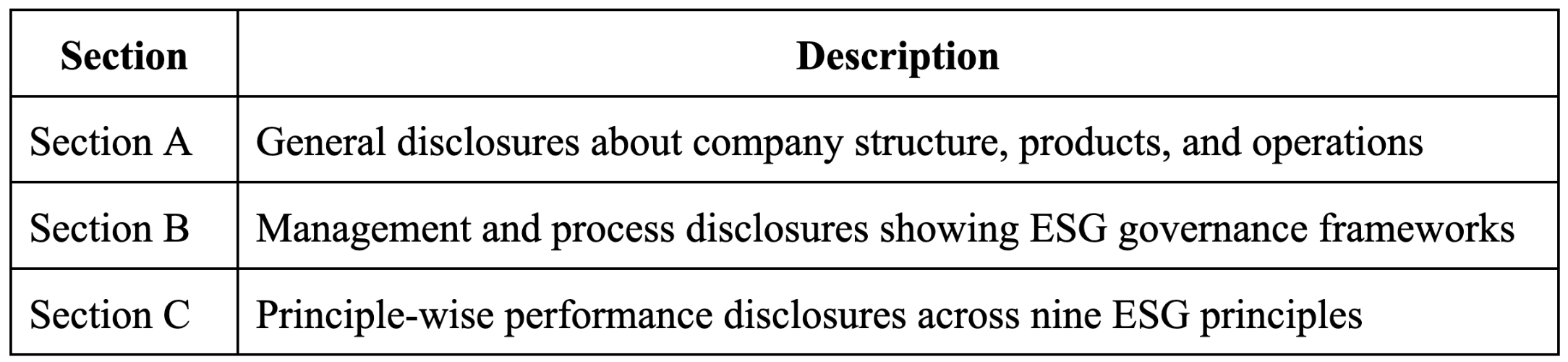
SEBI BRSR guidelines organize disclosures into three sections:
Who Needs to Comply with BRSR?
Who needs to comply with BRSR depends on listing status, market capitalization, and financial year thresholds.
Mandatory Compliance
BRSR reporting became mandatory from FY 2022-23 for:
- Top 1,000 listed companies by market capitalization (calculated as of March 31 each year)
- Companies must file BRSR compliance reports as part of their annual reports
Market capitalization rankings shift annually. Companies moving into the top 1,000 must begin BRSR reporting immediately. Companies dropping below the threshold can voluntarily continue reporting or pause until re-entering the mandate.
Voluntary Adoption
Companies outside the top 1,000 can adopt BRSR reporting voluntarily. Benefits include:
- Early preparation for future mandatory compliance
- Improved investor transparency
- Alignment with global ESG disclosure expectations
- Competitive positioning in sustainability-conscious markets
.jpeg)
BRSR Reporting Structure: Nine Principles
SEBI BRSR guidelines organize performance disclosures around nine principles covering environmental, social, and governance dimensions. The BRSR framework in India is structured around nine principles covering environmental, social, and governance aspects.
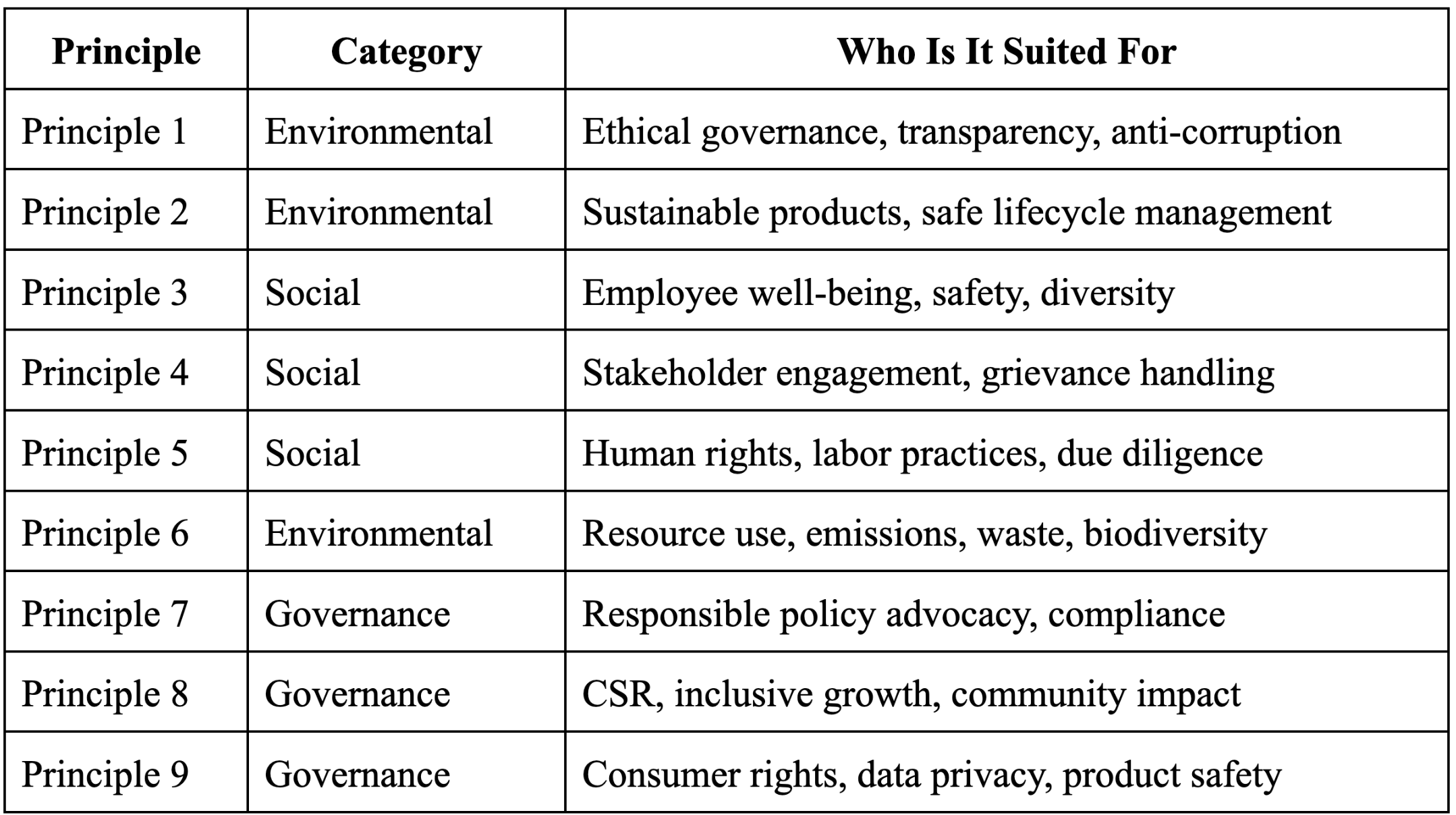
Environmental Principles
Principle 1: Businesses should conduct and govern themselves with integrity, in a manner that is Ethical, Transparent and Accountable
Disclosures cover:
- Anti-corruption policies and training
- Transparency in operations and stakeholder communication
- Whistleblower mechanisms and grievance redressal
Principle 2: Businesses should provide goods and services in a manner that is sustainable and safe
Disclosures cover:
- Product lifecycle management
- Sustainable sourcing practices
- Extended producer responsibility compliance
- Product recalls and safety incidents
Principle 6: Businesses should respect and make efforts to protect and restore the environment
Disclosures cover:
- Energy consumption (renewable and non-renewable)
- Water withdrawal and discharge
- Air emissions (GHG and non-GHG)
- Waste generation and management
- Biodiversity impact assessments
- Environmental management systems
Social Principles
Principle 3: Businesses should respect and promote the well-being of all employees, including those in their value chains
Disclosures cover:
- Employee count by category (permanent, contract, differently-abled)
- Worker safety metrics (injuries, fatalities, lost days)
- Training hours per employee
- Wage ratios and equal remuneration
- Benefits coverage (retirement, parental leave, insurance)
Principle 4: Businesses should respect the interests of and be responsive to all its stakeholders
Disclosures cover:
- Stakeholder identification and engagement processes
- Vulnerable and marginalized stakeholder groups
- Grievance redressal mechanisms
- Community impact assessments
Principle 5: Businesses should respect and promote human rights
Disclosures cover:
- Human rights due diligence processes
- Child labor and forced labor policies
- Assessments of high-risk operations
- Training on human rights
- Remediation mechanisms for violations
Governance Principles
Principle 7: Businesses, when engaging in influencing public and regulatory policy, should do so in a manner that is responsible and transparent
Disclosures cover:
- Trade association memberships
- Public policy advocacy positions
- Anti-competitive behavior incidents
Principle 8: Businesses should promote inclusive growth and equitable development
Disclosures cover:
- CSR spending and impact measurement
- Preferential procurement from local and small suppliers
- Community development initiatives
- Intellectual property licensing
Principle 9: Businesses should engage with and provide value to their consumers in a responsible manner
Disclosures cover:
- Product labeling and information disclosure
- Customer privacy and data security
- Product recalls and complaints
- Consumer education initiatives
Under SEBI BRSR guidelines, companies must mandatorily report essential BRSR disclosures, while leadership indicators remain voluntary.

Core And Advanced Metrics For BRSR Guidelines
BRSR reporting requires responses to Essential Indicators (mandatory quantitative and qualitative metrics) and Leadership Indicators (advanced metrics for mature ESG programs).
Essential Indicators: Core Metrics
Every company must report Essential Indicators. Examples include:
Environmental metrics:
- Total energy consumption from renewable and non-renewable sources (GJ)
- Water withdrawal by source (kiloliters)
- Total Scope 1, Scope 2, and material Scope 3 GHG emissions (tonnes CO₂e)
- Waste generated and diverted from disposal (metric tonnes)
Social metrics:
- Total employees by gender and category
- Median remuneration and wage ratios
- Occupational injuries and fatalities
- Hours of training per employee
Governance metrics:
- Board composition and independence
- Anti-corruption training coverage
- Material ESG risks and mitigation measures
Leadership Indicators: Advanced Metrics
Leadership Indicators are optional but demonstrate mature ESG regulations in India compliance. Examples include:
- Life Cycle Assessments for products
- Extended producer responsibility collection targets
- Science-based emission reduction targets
- Diversity metrics beyond gender (caste, ethnicity, age)
- Living wage implementation
Organizations with established ESG programs report Leadership Indicators to showcase advanced sustainability integration.
BRSR Compliance Timeline and Filing Requirements
BRSR compliance follows the financial year reporting cycle.
Annual Filing Deadline
Companies must file BRSR reporting as part of their Annual Report, typically within three months of financial year-end. For companies following April-March fiscal years, the deadline falls around June-July.
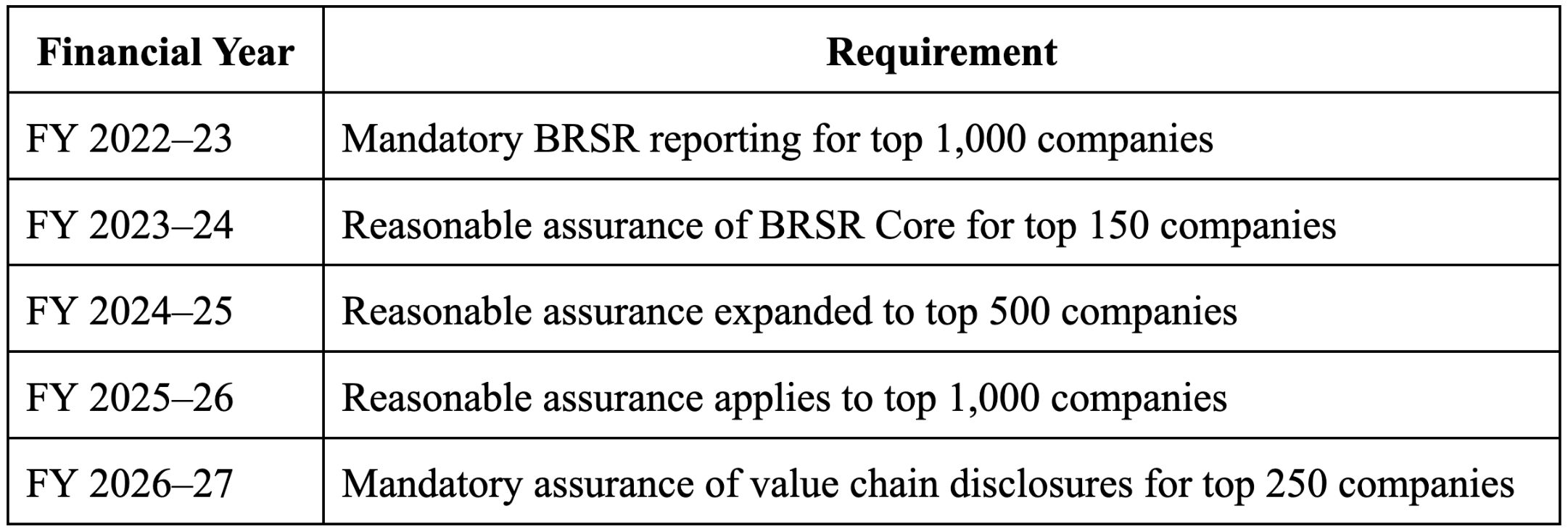
Phased Implementation
SEBI rolled out BRSR requirements in phases:
First-Time Reporting Considerations
Organizations filing their first BRSR report face data availability challenges. SEBI BRSR guidelines permit:
- Using "Not Applicable" for genuinely irrelevant metrics
- Disclosing "Data Not Available" with planned timelines for collection
- Reporting partial data with explanations
However, repeated use of "Data Not Available" creates compliance risk and investor skepticism. Establish data collection systems immediately to improve reporting quality year-over-year.

BRSR Core: The Assurance Requirement
SEBI introduced BRSR Core in May 2023 - a subset of Key Performance Indicators (KPIs) from the full BRSR framework requiring reasonable assurance. BRSR Core compliance became mandatory from FY 2023-24 for the top 150 listed companies, expanding to the top 1,000 over subsequent years.
BRSR Core identifies specific quantitative metrics that must undergo third-party verification to reasonable assurance standards. This elevates ESG reporting India from self-declared disclosures to audited, verified data comparable to financial statement assurance. These BRSR requirements in India apply as per SEBI’s ESG reporting guidelines.
BRSR Core Scope
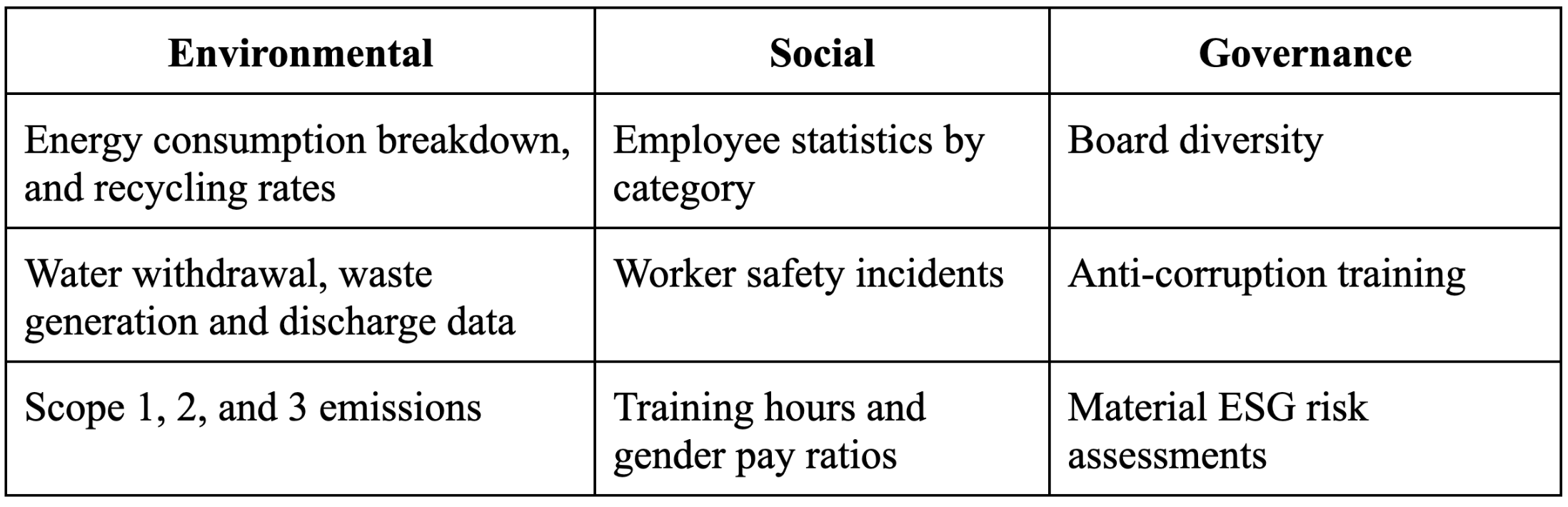
The BRSR Core framework is built around 9 key ESG attributes - ranging from GHG and Water Footprints to Gender Diversity and Inclusive Development - which comprise roughly 30 mandatory data points requiring rigorous verification. These include:
Reasonable Assurance Standards
BRSR Core requires reasonable assurance - the same confidence level applied to financial audits. This exceeds limited assurance (used in many voluntary ESG reports) and demands:
- Rigorous evidence collection
- Detailed testing of data accuracy
- Verification of calculation methodologies
- Assessment of internal controls
- Comprehensive documentation trails
Organizations need robust data management systems to withstand reasonable assurance scrutiny. To select the right assurance providers, you should look for:
- Accreditation from recognized bodies (ISAE 3000, AA1000AS)
- Experience in ESG data verification
- Sector-specific knowledge relevant to your operations
- Capacity to verify both qualitative disclosures and quantitative metrics
- Assurance costs vary based on organizational complexity, data maturity, and scope coverage. Budget for initial engagements to take longer as providers establish baseline understanding.

5 Common BRSR Reporting Challenges
1. Data Availability Across Operations
BRSR reporting demands data from multiple functions - operations, HR, procurement, facilities, legal. Organizations struggle when:
- Data lives in disconnected systems (ERP, HRIS, utility portals)
- Facilities lack metering infrastructure for energy or water
- Suppliers cannot provide Scope 3 emissions data
- Manual processes create version control issues
Centralized data collection platforms streamline inputs from multiple sources and maintain audit trails.
2. Scope 3 Emissions Calculation
ESG reporting India mandates disclosure of material Scope 3 categories. Most organizations find:
- Purchased goods and services represent 50-80% of carbon footprint
- Suppliers lack emissions data or refuse to share
- Spend-based estimation provides only rough approximations
- Transportation and logistics data requires carrier collaboration
Start Scope 3 reporting with spend-based calculations, then implement supplier engagement programs to upgrade data quality annually.
3. Quantifying Social Impact
Metrics like "number of beneficiaries from CSR projects" or "percentage of local procurement" require:
- Clear definition of beneficiary counting methodologies
- Geographic boundaries for "local" classification
- Systems to track outcomes beyond financial spending
Document methodologies transparently. Auditors assess consistency more than perfection.
4. Managing Multiple Reporting Frameworks
Indian companies with international operations or investors often report to multiple frameworks:
- BRSR for SEBI compliance
- GRI Standards for global stakeholder reporting
- CDP for climate disclosure
- TCFD for financial risk assessment
- CSRD if operating in the EU
Data overlaps exist, but each framework structures disclosures differently. Map your data collection to cover all framework requirements without duplicating effort.
5. Resource and Expertise Constraints
BRSR compliance requires dedicated resources. Challenges include:
- Small sustainability teams managing comprehensive data collection
- Limited internal expertise in carbon accounting or ESG metrics
- Competing priorities during financial year-end reporting periods
- Budget constraints for assurance providers and technology platforms
Organizations unable to build internal capacity partner with ESG consultants or deploy specialized reporting software.

Best Practices for BRSR Reporting
Establish Cross-Functional Governance
Create an ESG steering committee with representatives from:
- Operations (energy, water, waste data)
- HR (employee metrics, safety, training)
- Procurement (supplier assessments, local sourcing)
- Legal and compliance (governance policies)
- Finance (assurance coordination, budget allocation)
- Corporate communications (report publication)
Assign clear ownership for each BRSR principle. Designate one leader to coordinate overall BRSR reporting timelines.
Implement Centralized Data Systems
Manual spreadsheet-based ESG reporting India processes break down as data volumes grow. Purpose-built platforms:
- Centralize data from multiple sources
- Automate calculations (emissions, intensity ratios)
- Apply validation rules to flag anomalies
- Generate framework-specific outputs (BRSR, GRI, CDP)
- Maintain audit trails for assurance
Technology investment reduces manual work, improves accuracy, and prepares organizations for expanding disclosure requirements.
Start Early and Iterate
BRSR reporting quality improves over multiple cycles. First-time reporters should:
- Begin data collection 6-9 months before year-end
- Identify gaps early and establish collection processes
- File initial reports acknowledging data limitations
- Improve granularity and coverage year-over-year
Perfection is unattainable in year one. Demonstrate progress through systematic improvement.
Engage Suppliers on ESG Data
Scope 3 emissions and supply chain labor practices require supplier collaboration. Effective engagement strategies include:
- Integrating ESG questionnaires into vendor onboarding
- Prioritizing data collection from top suppliers by spend
- Offering training on emissions calculation to key partners
- Incentivizing ESG performance in procurement decisions
Supplier engagement takes time. Start with your largest 20% of suppliers representing 80% of spend.
Prepare for Assurance Early
BRSR Core reasonable assurance demands evidence beyond self-declaration. Build audit-ready documentation:
- Maintain source documents (utility bills, payroll records, certificates)
- Document calculation methodologies and assumptions
- Retain evidence of policy implementation (training records, meeting minutes)
- Prepare narrative explanations for year-over-year changes
Internal audit teams can conduct pre-assurance reviews to identify control weaknesses before external providers engage.

How BRSR Aligns with Global ESG Standards
SEBI BRSR guidelines intentionally align with international frameworks to reduce reporting burden for multinational organizations.
GRI Standards Alignment
BRSR maps closely to GRI Standards, particularly:
- GRI 2 (General Disclosures)
- GRI 300 series (Environmental topics)
- GRI 400 series (Social topics)
Organizations reporting to both BRSR and GRI can use shared data sets with framework-specific structuring.
CSRD/ESRS Compatibility
European Sustainability Reporting Standards (ESRS) under CSRD share common metrics with BRSR, especially:
- GHG emissions (Scope 1, 2, 3)
- Energy consumption
- Water management
- Employee metrics
Indian subsidiaries of EU parent companies can harmonize BRSR reporting with CSRD disclosures.
UN Sustainable Development Goals
BRSR explicitly requires companies to identify which SDGs their business activities impact. This creates strategic alignment between regulatory compliance and broader sustainability commitments.
Task Force on Climate-related Financial Disclosures
BRSR incorporates climate risk elements similar to TCFD recommendations:
- Climate-related risks and opportunities
- Governance over climate matters
- Emissions reduction targets
- Scenario analysis (Leadership Indicator)
Organizations advancing TCFD implementation can leverage outputs for ESG regulations in India compliance.

Technology Solutions for BRSR Compliance
Scalable BRSR reporting requires purpose-built ESG platforms that automate data management and framework alignment.
Essential Platform Capabilities
- Data centralization: Consolidate inputs from facilities, business units, and third parties into single source of truth.
- Automated calculations: Apply emission factors, intensity ratios, and aggregations without manual spreadsheet formulas.
- Framework mapping: Tag collected data to multiple reporting requirements (BRSR, GRI, CSRD, CDP) simultaneously.
- Collaboration workflows: Enable distributed teams to input data with role-based access and approval chains.
- Audit trail management: Maintain version history, source documentation, and methodology records for assurance providers.
- Multi-year tracking: Compare performance year-over-year and visualize progress toward targets.
Breathe ESG for BRSR Reporting
Breathe ESG's platform addresses BRSR compliance requirements through:
- BRSR-specific templates: Pre-configured reporting structure matching SEBI BRSR guidelines format, including Section A, B, and C layouts.
- BRSR Core indicator tracking: Dedicated workflows for the 50+ KPIs requiring reasonable assurance, with enhanced documentation requirements.
- GHG emissions automation: Scope 1, 2, and 3 calculation aligned with GHG Protocol, supporting ESG reporting India carbon disclosure mandates.
- Multi-framework support: Simultaneous reporting to BRSR, GRI, CSRD, and CDP from centralized data set.
- Assurance readiness: Audit trail generation, evidence management, and report exports formatted for third-party verification.
Organizations using Breathe ESG reduce BRSR reporting preparation time by 50%+ while improving data accuracy for external assurance.

The Future of ESG Regulations in India
ESG regulations in India continue evolving beyond current BRSR mandates.
Expansion of Mandatory Reporting
SEBI may extend BRSR compliance to companies beyond the top 1,000 or adjust market capitalization thresholds. Voluntary adoption positions organizations ahead of future mandates.
Increased Assurance Requirements
BRSR Core reasonable assurance currently applies to top 150-1,000 companies on a phased timeline. SEBI could expand assured metrics beyond the current KPI subset or accelerate rollout timelines.
Climate-Specific Disclosures
India's commitment to net-zero by 2070 may drive sector-specific climate disclosure requirements, particularly for carbon-intensive industries like power, steel, cement, and transportation.
Supply Chain Due Diligence
Global regulations like EU's Corporate Sustainability Due Diligence Directive create pressure for Indian exporters to implement supply chain ESG assessments. Future SEBI BRSR guidelines may incorporate supply chain responsibility metrics.
Digital Reporting Standards
XBRL or similar digital taxonomy for ESG reporting India could standardize data formatting, enabling automated analysis and comparison across companies.
Getting Started with BRSR Reporting
Organizations beginning BRSR compliance should prioritize:
Month 1-2: Assessment and gap analysis
- Review SEBI BRSR guidelines and identify applicable principles
- Assess current data availability across Essential Indicators
- Map existing ESG initiatives to BRSR disclosure requirements
- Identify data gaps and collection challenges
Month 3-4: Data infrastructure setup
- Assign ownership for each principle to functional leaders
- Establish data collection processes and timelines
- Deploy centralized platform or template system
- Begin supplier engagement for Scope 3 and supply chain metrics
Month 5-8: Data collection and validation
- Gather data from operations, HR, procurement, facilities
- Calculate emissions, intensity metrics, and aggregations
- Document methodologies and assumptions
- Conduct internal review for completeness
Month 9-10: Report drafting and review
- Compile disclosures in BRSR format
- Prepare narrative explanations for performance trends
- Engage assurance providers if within BRSR Core scope
- Conduct management review
Month 11-12: Assurance and filing
- Complete assurance engagement for BRSR Core indicators
- Finalize report incorporating assurance findings
- Submit as part of Annual Report to stock exchanges

Simplify BRSR Compliance With Breathe ESG
BRSR implementation comes down to systematic data management, cross-functional coordination, and technology enablement. With Breathe ESG, organizations can simplify reporting, automate data collection, and gain real-time ESG insights—turning compliance into a strategic advantage rather than a checkbox exercise.
As ESG reporting requirements in India continue to intensify, adopting a robust, tech-enabled BRSR framework helps companies stay ahead of evolving SEBI mandates while strengthening transparency and investor confidence.
Book a demo today to streamline BRSR Reporting with Breathe ESG.
FAQs
What is the purpose of BRSR Reporting?
BRSR reporting helps companies disclose their environmental, social, and governance performance in a structured manner. It improves transparency and allows investors and stakeholders to evaluate sustainability practices effectively.
Is filing of BRSR mandatory?
Filing BRSR is mandatory for the top 1,000 listed companies in India based on market capitalization. Other companies can adopt it voluntarily to enhance their ESG disclosures.
What is the difference between ESG and BRSR?
ESG is a broad concept covering environmental, social, and governance factors used globally. BRSR is a specific reporting framework introduced in India to standardize ESG disclosures for companies.
How to do BRSR reporting?
Start by collecting relevant ESG data across operations and policies. Then align the data with BRSR format, complete required sections, and include it in the company’s annual report as per regulatory guidelines.